Short Bone Rongeur (Double-Action, Curved, 15cm) – Premium 420-Series German Stainless Steel | BusinessMed Instruments
In the demanding fields of orthopedic, maxillofacial, and neurosurgery, precision is measured in millimeters, and control is defined by fatigue. Single-action rongeurs or inferior steel instruments force the surgeon to exert excessive grip force, leading to rapid hand fatigue—a critical factor in the 65% strain rate reported in high-volume surgical environments. This not only reduces tactile feedback, increasing the risk of micro-fractures or soft tissue damage but also compromises procedural efficiency.
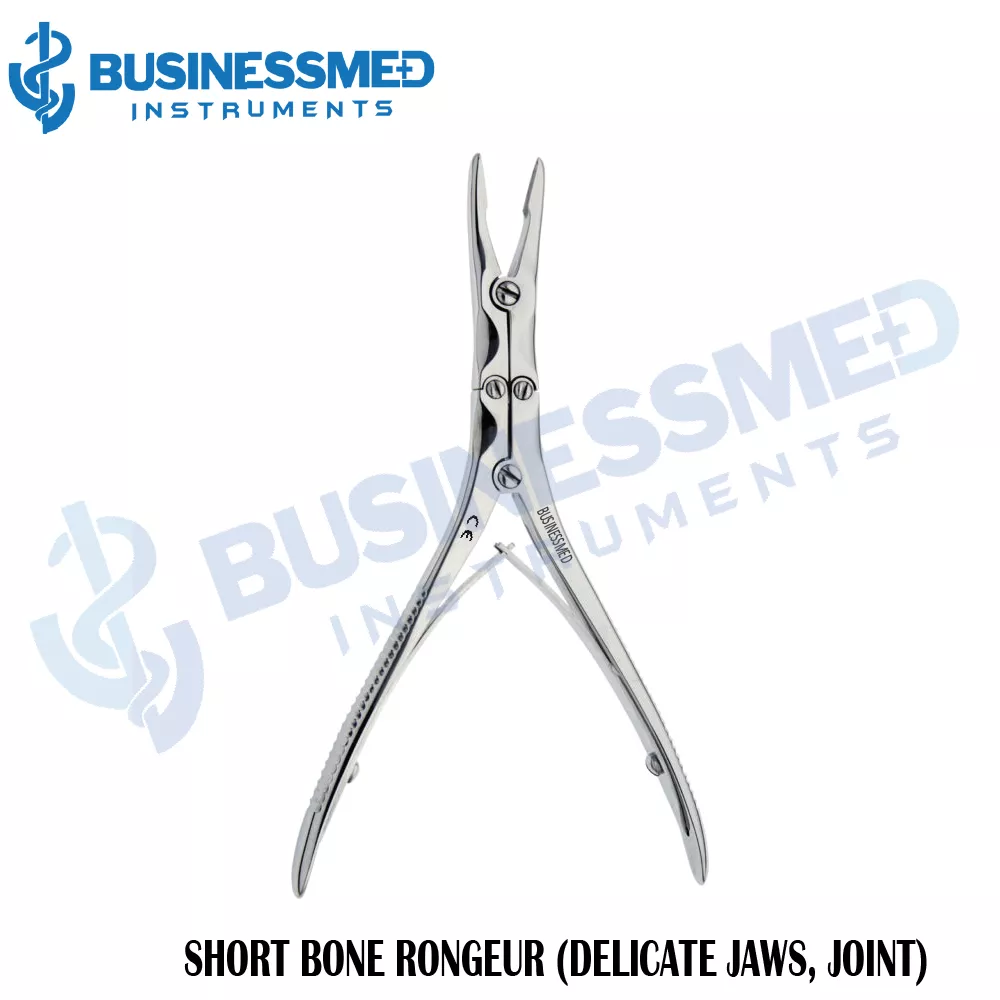
The BusinessMed Short Bone Rongeur (Double-Action, Curved, 15cm) is engineered as a true extension of the surgeon’s hand. Its double-action joint mechanically multiplies input force, allowing for clean, controlled bone nibbling with minimal effort. The 15cm (5.9 in) curved profile is optimized for Ambulatory Surgical Centers (ASCs) and hospital settings, providing unparalleled access to confined spaces like the carpal tunnel or mandibular angle. The result is a significant reduction in surgeon fatigue, cleaner bone margins, and safer, faster procedures.
Procedural Application Matrix
| Discipline | Specialty | Application | Anatomical Target |
|---|---|---|---|
| Orthopedic Surgery | Hand & Upper Extremity | Debridement of bone edges, osteophyte removal, phalangeal contouring | Carpal bones, proximal/middle phalanges, metacarpals |
| Orthopedic Surgery | Foot & Ankle | Trimming bone spurs (exostosis), preparing joint fusion sites | Calcaneus, metatarsals, phalanges |
| Maxillofacial Surgery | Oral & Craniofacial | Bone trimming during mandibular reconstruction, removal of tooth fragments | Mandible, maxilla, alveolar ridge |
| Neurosurgery | Spinal & Cranial | Controlled, delicate bone nibbling for laminotomy or craniectomy access | Vertebral lamina, thin cranial bone |
Technical Deep-Dive (Material Science)
-
Metallurgical Integrity: Manufactured from Martensitic 420-series German surgical grade stainless steel. This high-carbon martensitic alloy is specifically chosen for its superior balance of hardness and toughness. With a hardness rating of 50-55 HRC, the cutting edges maintain their sharpness through hundreds of sterilization cycles, resisting the deformation and jaw misalignment common in lower-grade alternatives.
-
Advanced Passivation Process: Each rongeur undergoes a multi-stage, validated passivation process that creates a uniform, chromium-rich oxide layer. This is critical for ensuring maximum corrosion resistance against the corrosive agents in saline, blood, and enzymatic detergents. This process also removes surface contaminants, reducing infection risk and ensuring long-term compliance with the most stringent sterilization protocols.
-
Double-Action Joint & Ergonomics: The double-action mechanism is the defining feature of this instrument. By using a compound hinge, it translates a small input force from the surgeon’s hand into a significantly amplified cutting force at the jaw. This design, combined with an ergonomic handle profile, directly addresses surgeon fatigue, providing precise control and superior tactile feedback for differentiating between cortical and cancellous bone.
The BusinessMed Entity Tables
Clinical Intelligence
| Discipline | Specialty | Procedural Indication | Anatomical Target |
|---|---|---|---|
| Orthopedic Surgery | Hand & Wrist | Carpal tunnel release, trigger finger surgery, fracture debridement | Trapezium, scaphoid, phalangeal bases |
| Orthopedic Surgery | Podiatry | Hammertoe correction, bunionectomy (exostectomy) | Proximal phalanx, metatarsal head |
| Maxillofacial Surgery | Dental Implantology | Alveoloplasty for implant site preparation | Alveolar ridge |
| Neurosurgery | Minimally Invasive Spine | Laminotomy for nerve root decompression | Vertebral lamina |
Technical Authority
| Attribute | Specification |
|---|---|
| Metallurgy | Martensitic 420-Series German Stainless Steel |
| Hardness Rating | 50-55 HRC (Rockwell Hardness Scale) |
| Surface Finish | Satin finish, non-reflective; passivated for corrosion resistance |
| Configuration | Double-Action Joint; Curved Jaw Profile; Length: 15 cm (5.9 in) |
| Jaw Type | Standard (for general bone work) / Delicate (for fine, atraumatic nibbling near soft tissue) |
| Certifications | ISO 13485:2016, CE (MDR 2017/745), FDA (Class I Medical Device) |
Procurement & Value
| Attribute | BusinessMed Advantage |
|---|---|
| UDI-Ready Asset Identity | Laser-etched with a GS1 2D DataMatrix code. Enables instant asset tracking, preventing the loss of high-value instruments and ensuring tray completeness for ASC efficiency. |
| Clinical Workflow Integration | Engineered to precise clinical specifications for seamless adoption into hospital and ambulatory surgical center workflows without requiring technique adaptation. |
| Total Cost of Ownership (TCO) | Engineered for 1,000+ sterilization cycles vs. 200-400 for floor-grade alternatives, drastically reducing replacement frequency. |
| Sustainability | PFAS-free “Green Surgery” Compliance. Manufactured without per- and polyfluoroalkyl substances, supporting environmentally responsible procurement mandates. Packaged in 100% recyclable medical-grade materials. |
| Warranty | Lifetime Warranty against manufacturing defects in material and workmanship, including jaw misalignment. |
Total Cost of Ownership (TCO) Comparison
| Feature | BusinessMed (Premium 420-Steel) | Economical “Floor Grade” | Disposable Alternative |
|---|---|---|---|
| Joint Mechanism | Double-Action (Force Multiplying) | Single-Action (Direct Force) | Single-Action (Direct Force) |
| Material Quality | 420 German Steel (50-55 HRC) | 300-series or lower-grade 400-series | 300-series or lower-grade 400-series |
| Corrosion Resistance | Excellent (Validated Passivation) | Poor to Moderate (Pitting after <200 cycles) | N/A (Single Use) |
| Cutting Efficiency | High (Low force required) | Moderate (High force required) | Moderate (High force required) |
| Sterilization Lifespan | 1,000+ cycles | 200-400 cycles | Not Applicable |
| Asset Tracking (UDI) | Integrated (Reduces Loss) | Absent | Not Applicable |
| Sustainability (PFAS-free) | Yes (Regulatory Compliant) | Often Unknown | High Biohazard Waste Burden |
| 5-Year TCO / Unit | Low (Amortized) | High (Frequent Replacement) | Very High (Per-Procedure Cost) |
Authoritative FAQ
Q: What is the clinical advantage of a double-action joint over a single-action design?
A: A single-action rongeur requires the surgeon to apply the full cutting force directly. The double-action mechanism uses a compound hinge to multiply the applied force. This means the surgeon uses significantly less grip strength to achieve a clean cut, reducing hand fatigue during long or repetitive procedures (e.g., multiple osteophyte removals) and providing superior tactile feedback for greater control.
Q: When should I choose the “delicate jaw” variant?
A: The delicate jaw variant is designed for fine bone work in close proximity to critical soft tissue structures. It is ideal for procedures like:
-
Neurosurgery: Nibbling thin bone near the dura mater.
-
Maxillofacial Surgery: Removing small tooth fragments from the alveolar nerve.
-
Hand Surgery: Contouring small phalanges without damaging flexor tendons.
Q: How does the UDI-ready DataMatrix code benefit my facility?
A: The laser-etched GS1 2D DataMatrix code is a permanent, scannable asset identity. It allows your central sterile department to instantly track this instrument’s location, sterilization history, and maintenance schedule. This is a critical tool for preventing instrument loss—a significant cost driver—and ensuring tray completeness, which improves operating room efficiency.
Q: Is this rongeur compatible with steam sterilization, and what is its lifespan?
A: Yes. The 420-series steel and advanced passivation make it fully compatible with steam sterilization cycles at 121°C (250°F) to 134°C (273°F) . The instrument is engineered to withstand over 1,000 cycles without losing its cutting efficiency or corrosion resistance, provided standard sterilization protocols are followed. This longevity is the cornerstone of its superior Total Cost of Ownership.
Shipping & Delivery